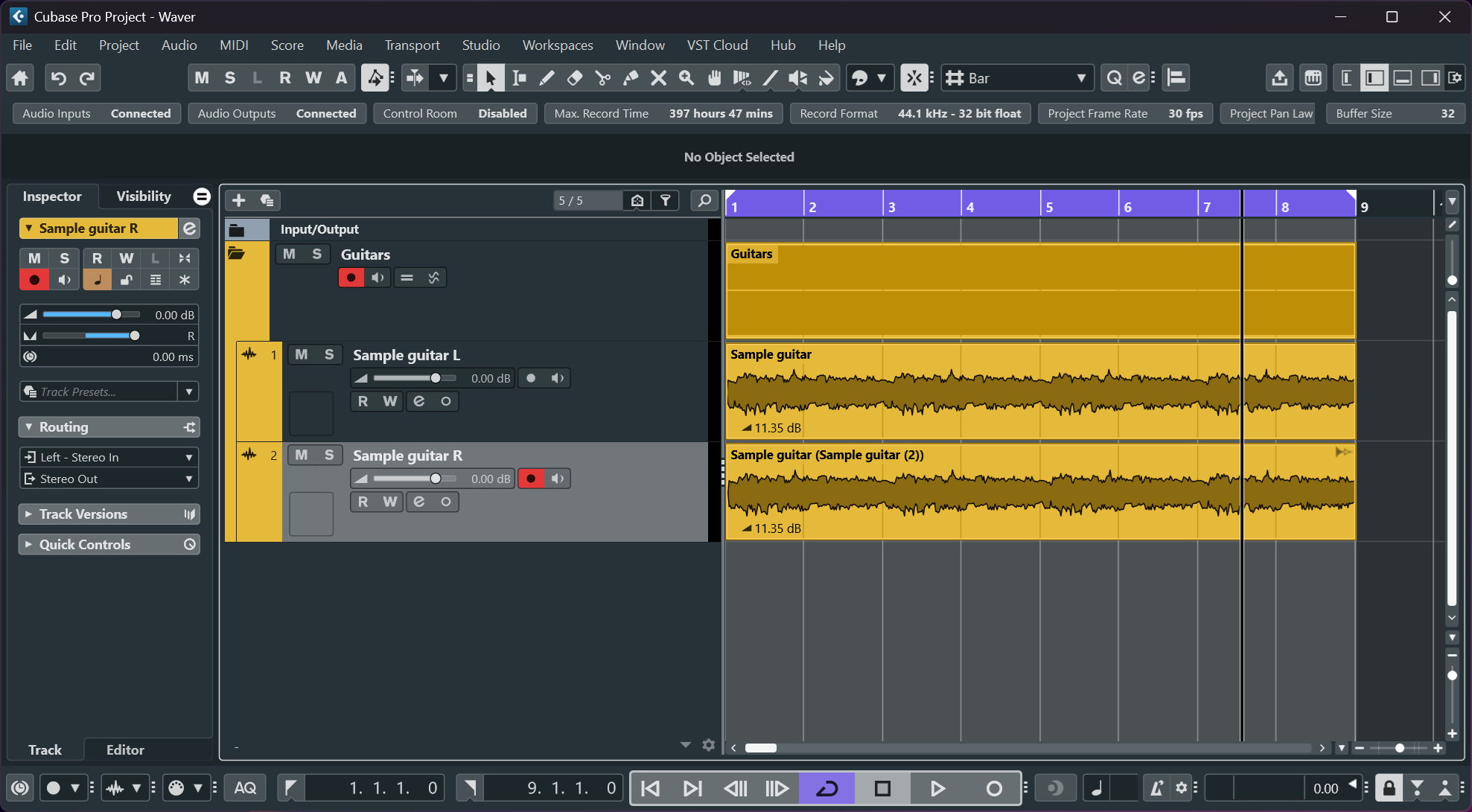
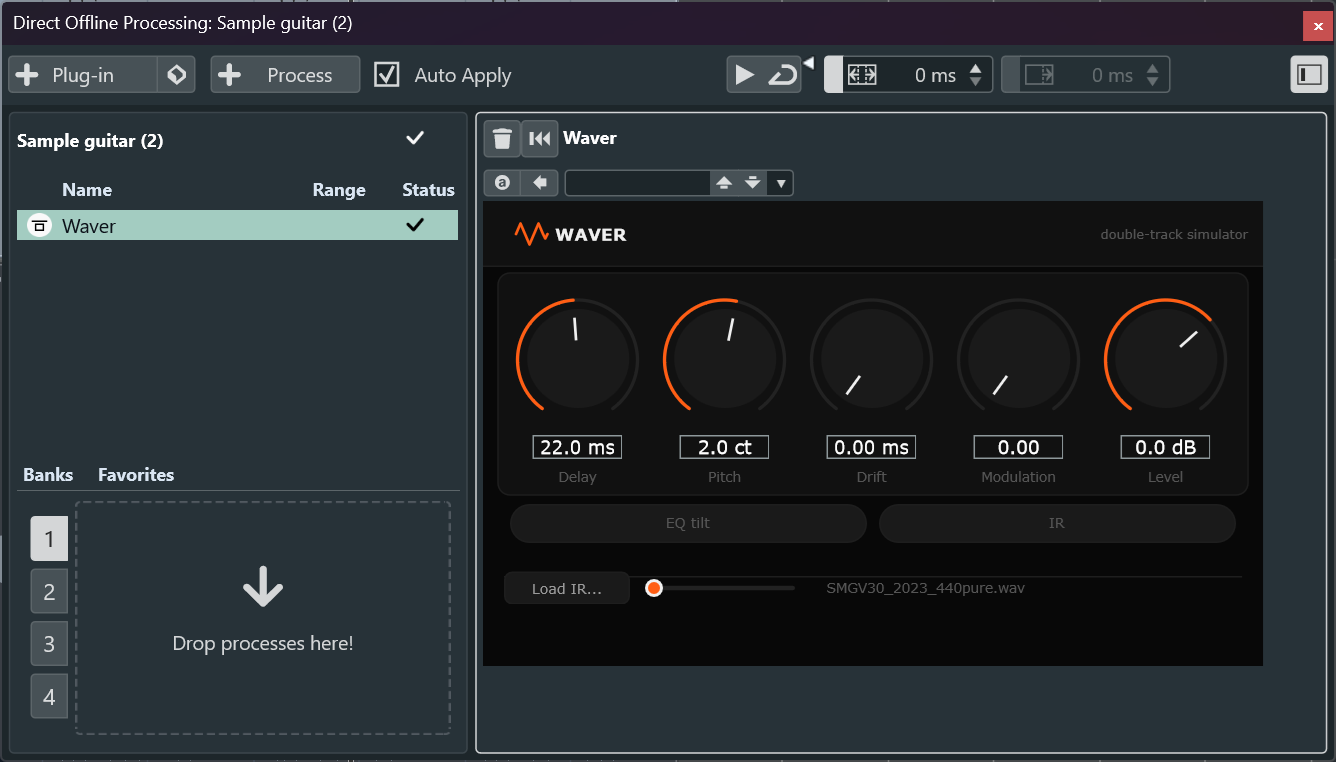
Waver simulates a double-tracked electric guitar from a single recording. Real-time stereo widening — no second take, no timing sync, no bleed.
A genuine double-tracked guitar — the same part played twice, panned hard left and right — is one of the most powerful sounds in rock and metal production. But recording two identical performances takes hours of studio time, and staying tight enough to sound cohesive without sounding like a chorus pedal is harder than it looks.
Waver lets you dial in the simulation during playback and mixing, without committing to audio early — and without any second take at all.
Simulates the three physical reasons a second take sounds different
Haas delay (5–40 ms) plus an IIR-smoothed random walk simulates the natural timing imprecision of a real second performance — not a chorus sine LFO.
Granular dual-pointer pitch shift with sin² crossfade. Up to ±25 cents. No STFT, no smearing — works on fully distorted signals.
Low band stays mono. Only the high band gets double-tracked. Sums to flat — no phase cancellation in the low end when the mix is folded to mono.
Load any WAV impulse response — different mic position, different room, different cab — and convolve it onto the simulated take only. Normalised on load.
Full PDC support — latency reported so Cubase compensates automatically. Works as a real-time insert or via Direct Offline Processing (F7). Project state and IR path save with the session.
tanh soft clipper on the output stage — starts acting at −6 dBFS and saturates gracefully, so hot or already-distorted recordings won't hard-clip through the chain.
Mono in. The signal is split and processed separately for L and R.
L = low + dry high · R = low + processed high
| Control | Range | Default | Description |
|---|---|---|---|
| Delay | 5–40 ms | 22 ms | Base Haas delay |
| Pitch | ±25 ct | +8 ct | Detune of simulated take |
| Drift | 0–5 ms | 1.8 ms | Random timing variation depth |
| Level | −12–+6 dB | −1.5 dB | Level of simulated take |
| Crossover | 60–300 Hz | 150 Hz | Mono/stereo split frequency |
| EQ tilt | on/off | on | −2.5 dB shelf cut @ 4 kHz |
| Swap L/R | on/off | off | Swap sides |
| Control | Description |
|---|---|
| Load IR | Load a WAV impulse response (room, mic, cabinet) |
| IR enabled | Toggle convolution on/off without unloading |
| IR mix | 0–100 % wet/dry blend on the B track |
Free and open source. Windows VST3, x64. Tested in Cubase 15.
Waver-windows-x64.zip
Waver.vst3 to C:\Program Files\Common Files\VST3\
git clone --recurse-submodules \
https://github.com/gurrish/waver-vst
cmake -B build -G "Visual Studio 17 2022" -A x64
cmake --build build --config Release